Artificial intelligence research has become closely associated with a handful of languages and platforms built for scale, Python for model development, large cloud providers for training infrastructure, a small set of dominant frameworks for deployment. That association is accurate but incomplete. A quieter and equally important part of AI research is happening inside open source ecosystems built on languages like R, where statistical rigor, reproducibility, and community driven tooling continue to shape how AI systems are built, evaluated, and trusted.
Statistical foundations still matter
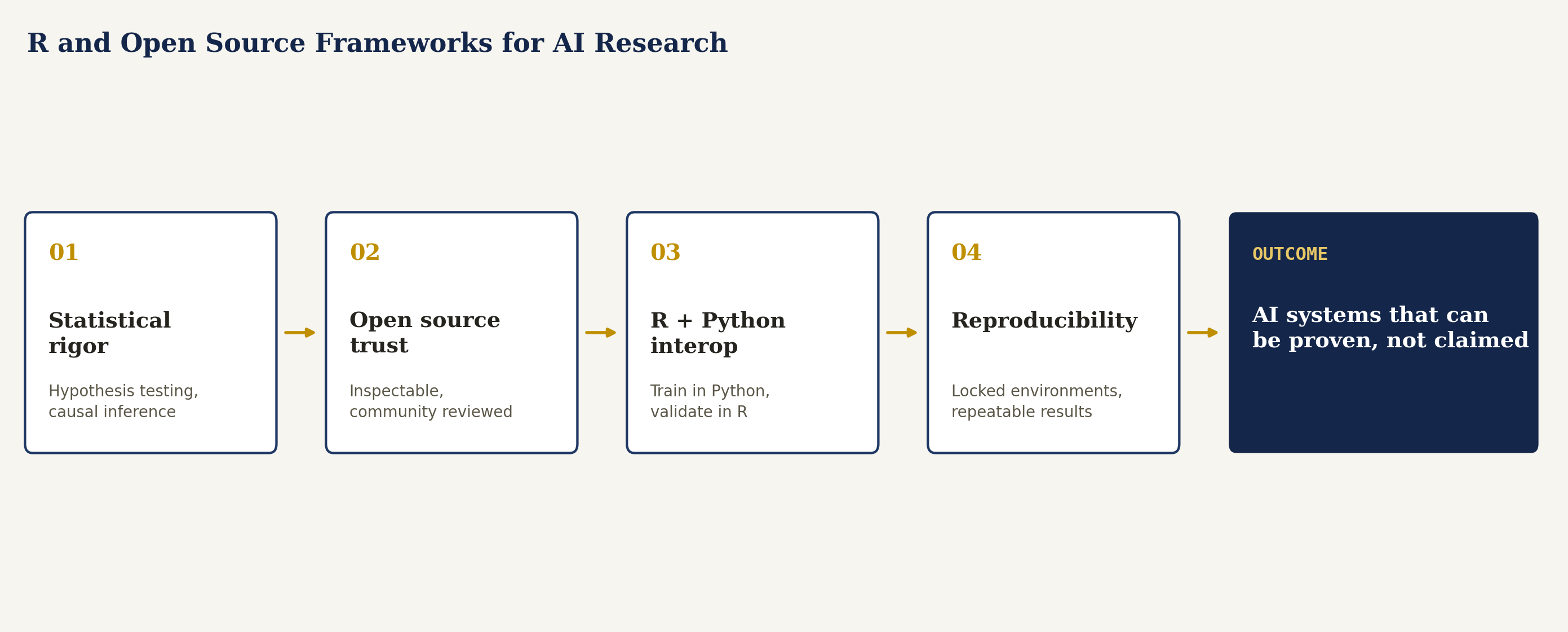
AI research is often described as an engineering discipline, and much of it is. But the systems being studied are still, underneath the tooling, statistical models. Understanding uncertainty, validating assumptions, testing for bias, and interpreting model behavior are statistical problems before they are software problems. R was built from the ground up for exactly this kind of work.
This matters more, not less, as AI systems move into regulated and high stakes environments. A model that performs well on average but fails unpredictably for a subset of users is not a research result ready for deployment, regardless of how well engineered the surrounding software is. The statistical discipline R's ecosystem has spent decades refining, hypothesis testing, confidence intervals, robust regression, causal inference, is directly applicable to the evaluation problems AI research is now treating as first class concerns.
Open source as the foundation of trust
One of the most consequential shifts in AI research over the past several years has been the move toward open evaluation and open tooling as a baseline expectation, not a nice to have. Closed, proprietary evaluation pipelines make it difficult for anyone outside a single lab to verify that a model behaves as a paper claims. Open source frameworks solve this by making the evaluation logic itself inspectable, reproducible, and improvable by a community rather than a single author.
This is where R's open source culture has an outsized influence. The CRAN ecosystem, and the broader R community around it, has for decades enforced a level of package documentation, testing, and peer review that many newer AI tooling ecosystems are only now catching up to. Applying that same discipline, reproducible results, versioned dependencies, transparent methodology, to AI evaluation and research tooling gives the field a path toward results that can actually be audited, rather than results simply trusted by default.
Where R fits into a Python dominated pipeline
R does not need to replace Python to be relevant to AI research, and treating the two as competitors misses how the most effective research teams actually work. Python remains the natural choice for model training, deep learning frameworks, and production deployment. R remains exceptionally strong for exploratory data analysis, statistical validation, visualization heavy diagnostic work, and the kind of rigorous experimental design that catches problems before a model ever reaches a paper or a product.
Interoperability tools have made this combination easier than it has ever been. Packages that let R and Python exchange data and call each other's functions directly mean a research team no longer has to choose one language and abandon the other. A model can be trained in Python and rigorously validated in R, with both steps treated as equally important parts of the same research pipeline rather than a tradeoff between speed and rigor.
Reproducibility as a research requirement
AI research has a reproducibility problem that is well documented and not fully solved. Models trained on slightly different data splits, evaluated with slightly different metrics, or run on slightly different software versions can produce results that are difficult to compare or trust. This is one of the reasons evaluation frameworks have become a serious focus of applied AI research rather than an afterthought.
R's package ecosystem has long treated reproducibility as a design requirement rather than an aspiration. Version locking, environment snapshots, and literate programming tools that combine code, results, and narrative into a single reproducible document are not new ideas in the R community, they are standard practice. Bringing that standard into AI research pipelines, particularly around evaluation and benchmarking, gives a much stronger foundation for claiming that a reported result is real and repeatable, not an artifact of a specific run.
The path forward
AI research is entering a phase where the question is shifting from can we build a capable model to can we prove the model behaves the way we claim, safely and consistently, across the conditions it will actually face. That is fundamentally a statistical and methodological question, not only an engineering one. Open source frameworks that carry forward decades of statistical rigor, and communities like the one built around R, have a meaningful role to play in answering it.
Resources to learn more
- tidymodels/tidymodelstidymodels — a unified, tidy framework for modeling and statistical validation in R
- mlr-org/mlr3mlr3 — a modern machine learning framework in R with rigorous benchmarking built in
- rstudio/reticulatereticulate — lets R and Python call each other directly in the same pipeline
- ropensci/targetstargets — a reproducible pipeline toolkit that tracks exactly what produced each result
- rstudio/renvrenv — project local environment management so results can be rerun later with the same dependencies
- responsibleai/ASSERTASSERT — an open source, spec driven evaluation framework for AI systems
Working on AI evaluation or research tooling?
I would like to hear how your team is thinking about reproducibility and open evaluation.
Write to info@italai.ai